
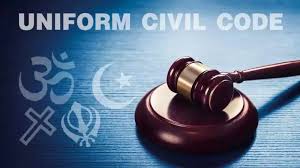
Setting the scene
With Uttarakhand enacting India’s first Uniform Civil Code Bill, the long-standing debate has shifted from discussion to implementation. This moment makes it important to trace how the idea of the UCC has developed through judicial decisions over the years.
Uniform Civil Code is made up of three terms each having a different meaning. Uniform means that the same law is applied to all in every situation. The word civil is related to citizen’s private rights like marriage, divorce, maintenance etc. Code refers to a collection of laws.
In this blog, we will look at how the Uniform Civil Code has developed through important court cases and how it has moved from being a topic of debate to becoming a law in practice.
Article 44 of the Indian Constitution
Article 44 of Constitution of India states that Indian Government should try to establish Uniform Civil Code for all the citizens across the country. Article 44 falls under Part IV which contains the Directive Principles of State Policy (DPSP). As per Article 37, these principles are not enforceable in court, but they are important guidelines for the government to follow when making laws.
Uniform Civil Code
Uniform Civil Code means a single law is made applicable to all citizens irrespective of their religion. The Uniform Civil Code is proposed in India to ensure that there is a common set of rules for all in order to ensure uniformity. UCC refers to a single law for matters related to custody,marriage, adoption, divorce, and inheritance.
The Constitution’s Article 25 guarantees freedom of religion, which totally opposes the UCC, since personal laws are closely linked to religious practices. In the Constituent Assembly debates, leaders like Dr. B.R. Ambedkar and K.M. Munshi supported a Uniform Civil Code to bring the country together. But some religious leaders were concerned it could affect their religious practices, so the UCC was placed in a part of the Constitution that the courts cannot enforce.
Why do we need Uniform Civil Code?
The most common question asked by the people is why do we need a Uniform Civil Code in India? We need Uniform Civil Code because it:
- Promotes national integration
- Reduces vote bank politics
- Addresses legal loopholes
- Symbolizes progressiveness
- Empowers women
- Ensures equality for all Indians
- Upholds true secularism
- Reflects natural evolution
- Compliant with constitutional provisions
- Enhances legal system efficiency
Landmark cases relating to Uniform Civil Code
Following are some of the important cases relating to Uniform Civil Code.
Mohd. Ahmed Khan vs. Shah Bano Begum And Ors (1985)
In this case, Shah Bano was divorced by her husband through triple talaq and refused maintenance. She went to court, and both the District Court and the High Court supported her. Her husband then took the matter to the Supreme Court, saying that under Islamic law he had already done what was required.
The Supreme Court, however, ruled in favour of Shah Bano under Section 144 of BNSS (previously Section 125 of CrPc), which says that a man must provide maintenance to his wife, children, and parents, no matter what religion they follow. The court also suggested bringing in a Uniform Civil Code (UCC) for fairness in such matters. While Muslim personal law only required maintenance for about 90 days (iddat period), Section 125 gave a wider right to support.
The judgment caused huge debates and protests, after which the government passed the Muslim Women’s (Protection of Rights on Divorce) Act, 1986, which reduced the effect of the ruling by excluding Muslim women from Section 125.
Ms. Jordan Diengdeh vs. S.S. Chopra (1985)
In this case, the Supreme Court discussed the lack of uniformity in marriage laws. It noted that rules on issues like divorce or judicial separation were different for people of different religions.
The court said there should be common provisions, such as divorce by mutual consent and on grounds like irretrievable breakdown of marriage, which should apply to everyone equally, no matter their religion. The court also stressed the need for a Uniform Code on marriage and divorce and directed that a copy of its judgment be sent to the Ministry of Law and Justice for consideration
Smt. Sarla Mudgal, President, Kalyani & Ors. vs. Union Of India & Ors. (1995)
In this case, the Supreme Court was directed again towards Article 44. The main question involved in the case was can a Hindu man, already married under Hindu law, convert to Islam just to marry again? The court replied in negative. Converting into Islam only for the purpose of remarriage is misusing the personal laws which are established.
The first hind marriage is still considered valid and changing religion does not entail that the marriage has ended. The wife can seek divorce on the basis of the husband converting into another religion. So, even if the husband remarries after converting the second marriage will be null and void. The husband can be punished for bigamy.
The court in this case highlighted the need for a Uniform Civil Code, so that the application of personal laws is done fairly and no one misuses them. It directed the government to file an affidavit explaining what steps it has taken towards bringing in the UCC.
Pannalal Bansilal Pitti & Ors. Etc vs. State Of Andhra Pradesh & Anr (1996)
In this case, the Supreme Court said that having a Uniform Civil Code (UCC) is very desirable, but implementing it all at once could create problems. The court suggested that changes should happen gradually, with laws being made and updated step by step. This slow and careful approach, the court said, would help maintain the unity and integrity of the nation.
Lily Thomas, Etc. Etc. vs Union Of India & Ors. (2000)
In this case, a Hindu wife said that her husband had converted to Islam and married again without ending their first marriage. The main questions were whether the second marriage was valid, whether the husband could be punished for bigamy under Section 494 of the IPC, and whether a Uniform Civil Code (UCC) was needed to prevent such problems. The court also looked at whether converting just to get around marriage laws could make a second marriage legal.
The Supreme Court ruled that a second marriage while the first spouse is alive is invalid under the Hindu Marriage Act, 1955. Conversion to Islam just to remarry was not accepted and did not remove the responsibilities from the first marriage. The husband was liable under Sections 494 and 495 of the IPC and Section 17 of the Hindu Marriage Act. The Court said religious freedom under Article 25 cannot harm the rights of others.
While the court acknowledged the need for a Uniform Civil Code, it recommended that changes be made gradually to respect India’s diverse religions and maintain national unity.
Joseph Shine vs. Union Of India (2018)
In this case, the Supreme Court struck down Section 497 of the IPC, which dealt with adultery, saying it went against Articles 14, 15, and 21 of the Constitution. The court stressed the importance of having gender-neutral laws and also suggested that bringing in a Uniform Civil Code (UCC) would help remove the inconsistencies that exist in different personal laws.
John Vallamattom & Anr vs. Union Of India (2003)
In this case, a priest from Kerala named John Vallamattom had filed a case arguing that Section 118 of the Indian Succession Act, 1925 was unfair to all Christians. As per this provision restrictions were put on how the Christians could donate property for charitable or religious purposes in their will.
The bench of the Supreme Court which was led by Chief Justice V.V. Khare agreed to him. The bench found this provision unconstitutional and struck it down. The Supreme Court also showed regret that Article 44 which talks about uniform laws and UCC is still not implemented. UCC can help in promoting national unity and will remove such differences present in the laws which are based on ideology or religion.
M/S Shabnam Hashmi vs. Union Of India & Ors (2014)
In this case, the Supreme Court said that the Juvenile Justice Act is an important step towards a Uniform Civil Code, as it gives a clear procedure for any person to adopt a child. The court added that while personal faiths and beliefs must be respected, personal laws cannot stop or block the working of national laws passed by Parliament.
Shayara Bano vs. Union Of India And Ors. (2017)
In this landmark case, a muslim woman named Shayara Bano went to the court to ask for maintenance from her husband. The husband had divorced her through triple talaq. Shayara had filed a case under Section 144 of BNSS (previously Section 125 of CrPc). This provision is applicable to all irrespective of their religion.
The Apex Court ruled in her favour. The court granted her maintenance, using secular law instead of Muslim personal law. But this decision faced strong opposition from Muslim clerics. In response, the government passed the Muslim Women (Protection of Rights on Divorce) Act, 1986, which limited the effect of the Supreme Court’s ruling. This case once again brought up the debate on having a Uniform Civil Code (UCC) in India.
Uttarakhand UCC Bill
The Uttarakhand Legislative Assembly has passed the Uniform Civil Code (UCC) Bill, 2024, aimed at standardising laws on marriage and property inheritance. The Bill is now pending the President’s assent to come into effect.
| Key features | Particulars |
| Prohibition of polygamy, halal, iddat, triple talaq, and child marriage | UCC bans multiple marriages, halal, iddat wait, triple talaq, and underage marriages for everyone. |
| Uniform age for girls’ marriage | Girls can marry only after turning 18, no matter their religion. |
| Equal property share for women | Women, including Muslim women, will get equal rights in family property. |
| Marriage ceremonies and rituals | Marriage can be done using any religion’s customs or traditions. |
| Prohibition on bigamy | No one can have more than one spouse. |
| Criminalization of customs imposing conditions on remarriage | Traditions that stop people from remarrying after divorce are illegal. |
| Penalization of extrajudicial divorce modes | Informal divorces not under UCC rules are punishable. |
| Punishment for different forms of divorce | Certain traditional divorce practices can lead to jail time. |
| Recognition of mehr and dower | Mehr and dower payments will continue along with maintenance. |
| Guardianship and custody | Father stays the legal guardian; mother gets custody of children under five. |
| Non-applicability on the scheduled tribes | Scheduled Tribes are not included in UCC. |
| Registration of marriage and live-in relationships | Not registering marriage or live-in relations can lead to fines or jail. |
Goa Civil Code
The only state in India to have a Uniform Civil Code is Goa. The state has its own personal laws which are very different from the personal law followed by other states in the country. The civil laws in Goa are codified by the Goa family law or the Goa Civil Code. All the residents of Goa irrespective of their religion, language or ethnicity are covered under the Goa Civil Code.
The Goa Civil Code originated from the Portuguese Civil Code 1867, which was introduced in 1870. The same code was used even after merging the state in India. In the landmark case of Jose Paulo Coutinho vs. Maria Luiza Valentina Pereira (2019), the Supreme Court stated that Goa is a shining example where the Uniform Civil Code is followed, with only a few limited exceptions, and urged that such a system be followed across India.
The state has the same set of marriage laws which applies to all no matter what their religion is. Polygamy is not allowed in major communities like Hindus. The law makes sure that both sons and daughters share equal rights in parental property. In divorce, the common law is followed unlike the rest of the country where divorce laws vary from religion to religion. When we talk about inheritance, the law makes it compulsory for at least half of the family’s estate to go to legal heirs.This rule protects children and spouses from being denied their rightful share.
Conclusion
The Uniform Civil Code (UCC) aims to create one set of laws for all citizens on matters like marriage, divorce, adoption, and inheritance, ensuring equality and promoting national unity. Landmark Supreme Court cases such as Shah Bano, Sarla Mudgal, and Joseph Shine have highlighted gaps and inconsistencies in personal laws, showing the need for a UCC. Courts have emphasized that reforms should be introduced gradually to respect religious diversity while ensuring fairness.
The Uttarakhand UCC Bill, 2024 seeks to standardize family laws across all religions, banning practices like triple talaq, polygamy, and child marriage, while giving women equal property rights. Goa’s Civil Code provides a working example of a UCC, showing how uniform laws can protect citizens’ rights regardless of religion.

